Delta is deploying cutting-edge technology like AI and automation to ensure your bags arrive on time, during the holidays and beyond.
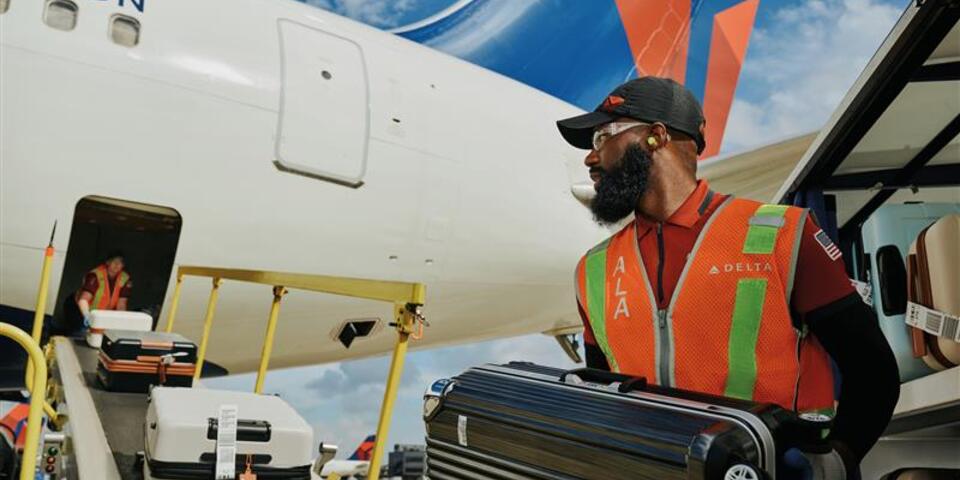
When 100,000 bags flow through Hartsfield-Jackson Atlanta International Airport on a peak travel day, getting each one to the right plane at the right time requires precise execution, innovation and the dedicated hard work of Delta people.
This holiday season, Delta is delivering that exceptional care with some powerful new tools, including AI, state-of-the-art Ground Support Equipment and a $110 million investment in advanced infrastructure that’s enhancing operational excellence on the ramp. This year, we’ve already handled more than 127 million bags worldwide. While fewer than 1% of bags are mishandled, each one matters and even one is too many. That’s why we’re focused on innovations that get every bag right.
For travelers flying through Atlanta – where approximately 40 percent of Delta’s customers pass through daily – reliable baggage transfer from one connecting flight to the next is critical for a smooth travel experience. That’s why we’ve been building and deploying innovation that is already delivering strong results, including a nearly 30% improvement in bag transfers, which translates to literally thousands more customers receiving their bags on time – a key driver behind our recent record-breaking baggage performance.
“Innovation isn’t just happening on our app or in the air, it’s transforming every corner of our operation, making it possible for Delta people to focus on what they do best: taking care of our customers, while new technology smooths logistics behind the scenes,” says Richard Cox, SVP, Airport Customer Service (ACS).
AI-powered routing keeps connections tight
At the heart of Delta’s baggage innovation is what the team calls “Baggage AI” – a powerful tool built entirely in-house by Delta people for Delta people that works like a ride-sharing app for the 250 ramp agents responsible for moving bags between aircraft.
The AI-powered platform uses real-time flight data, bag locations and connection minutes to create an optimized driving route for each driver, prioritizing bags with the tightest connections. Every two minutes, the system re-optimizes routes based on real-time conditions – gate changes, flight time adjustments, tight connections – ensuring drivers are always heading to the right place at the right time.
“It’s like having a copilot that knows exactly where you need to be and when,” says Mike Davis, an 11-year baggage transfer driver and multiple-time Driver of the Month based in Atlanta. “Beforehand, we relied solely on our experience and informed estimates. Now, the system shows us the most critical bags first, and we can move with confidence knowing we’re making the biggest impact.”
Designed to handle the complexity of Atlanta – the world’s busiest baggage operation, where a single arriving flight might connect to 50 or 60 departure gates across a massive footprint – Baggage AI is proving its value at a critical time.
With holiday travel in full swing, the Atlanta team manages an average of 87,000 bags daily, with peak holiday season seeing more than 110,000 bags daily. Given this success, plans are already underway to expand Baggage AI beyond Atlanta in 2026.
A $110 million investment in improved baggage flow
While AI enhances real-time coordination on the ramp, Delta is simultaneously upgrading the physical infrastructure that moves bags through Atlanta. This year, we’ve invested $40 million as part of a larger $110 million project to connect baggage systems in Concourses B, C and T, creating a more integrated, efficient baggage handling network across our busiest hub.
The scale of Delta’s Atlanta operation is staggering, representing one-fifth of our overall bag volume. The team has already handled nearly 27 million bags year-to-date – nearly 1 million more than last year – coordinating tight connections with little room for error. The enhanced baggage handling system gives our teams the infrastructure investment and modernization they need to do this work even more effectively.
Autonomy on the ramp: Safer, more consistent, more reliable
One of the most visible changes is on Concourse B, where Delta has deployed autonomous jet bridges – jet bridges that dock automatically with aircraft doors – the first in commercial aviation. These systems have supported more than 1,100 flights without a single aircraft damage incident or injury.
This outstanding safety record extends to Delta’s autonomous bag tugs, which have logged 4,000 miles in the Cargo facility and Terminal T bag room since 2023 – again, with zero injury or damage incidents. By year’s end, Delta expects to have 15 autonomous tugs in operation.
“Integrating autonomy into our Ground Support Equipment is about creating a safer, more consistent operation for our people that allows our teams to focus on the work that requires personalized judgment and care,” says Ramsey Hammad, managing director, ACS Strategy.
What’s next
Coming in 2026, Delta will enhance Baggage AI with even more sophisticated optimization to account for ramp congestion and weather-related delays. The system will also introduce autonomy into dispatching, automatically assigning drivers to nearby tasks based on where they completed their last run, eliminating empty drives across the airport and maximizing driver efficiency.
In addition, Delta plans to implement bag scanning for transfer drivers, creating new tracking points that will help locate and recover bags more quickly while enabling the system to adapt in real-time when, for instance, customers rebook themselves mid-flight.
The combination of AI-powered logistics, serious infrastructure investment and cutting-edge autonomous equipment represents Delta’s holistic approach to modernized operational excellence – one that touches every aspect of the customer journey.
As customers make their way through Atlanta this holiday season and into the new year, their bags are benefiting from some of the most advanced technology in commercial aviation. And if Delta’s recent performance is any indication, those bags will be waiting at baggage claim right where they’re supposed to be.
Related Topics: Customer Experience, Operations