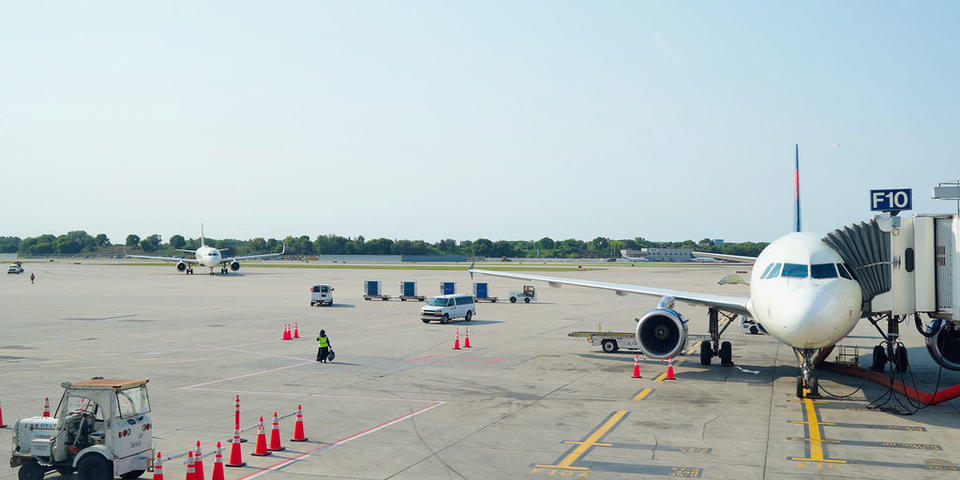
Minnesota will soon be home to a sustainable aviation fuel (SAF) blending facility – only the third in the United States – that will provide SAF supply via existing pipeline to the Minneapolis-St. Paul International Airport (MSP) – Delta’s second-largest hub where it uses 250 million gallons of fuel annually.
The first-of-its kind Minnesota SAF Hub – of which Delta is an anchor member along with the Greater MSP Partnership, Bank of America, Ecolab and Xcel Energy – launched in August 2023 with a commitment to implement an ambitious shared strategy for aggressively decarbonizing the airline industry by scaling SAF production and replacing conventional jet fuel. On Sept. 10, the coalition announced its achievements and four major milestones on its journey to develop a fully integrated SAF supply chain in Minnesota, thanks to collaboration across the coalition’s members representing the entire SAF value chain – from finance to farm to airport:
- The first SAF blending facility in Minnesota: Delta and Flint Hills Resources are in the early stages of developing a facility to blend up to 30 million gallons of neat SAF at its Pine Bend refinery in Rosemount, Minnesota. The facility is likely to be the first between the coasts that can blend neat SAF with conventional jet fuel. Shell will supply the neat SAF and bring its expertise in product quality, supply chains and logistics to the team. Flint Hills will blend the jet fuel it produces with the neat SAF and will deliver via Flint Hills’ existing pipeline to MSP. The facility is expected to be completed in late 2025.
- Making SAF cost-competitive: A “Demand Consortium” that includes Bank of America, Deloitte, Delta, and Ecolab has been formed to purchase the first several million gallons of SAF each year, starting in the second half of 2025. The goal: scale production, drive down costs and secure multi-year demand that spurs continued growth of the SAF market. Each of these companies are providing funding to support the market production of SAF, which will contribute to verified carbon emission reductions associated with their employee business travel.
- Establishing SAF production in Minnesota: On August 16, the Federal Aviation Administration announced a $16.8 million Inflation Reduction Act grant to convert an existing Gevo ethanol and isobutanol fuel facility in Luverne, Minnesota, into a fully integrated alcohol-to-jet fuel facility for SAF production. This will allow the first conversion of Minnesota crops to SAF within the state.
- Making SAF out of next-generation feedstocks: Coalition partners at the University of Minnesota are developing a novel crop called winter camelina seed, which can be used for a variety of purposes, including producing oil for conversion into SAF. Although this crop is early in its development, future opportunities are promising, and the MN SAF Hub is working to bring the first shipment of camelina-derived SAF to MSP this fall.
Minnesota is uniquely positioned to help scale the SAF industry and is why it’s an ideal location for this SAF Hub. Not only is Minnesota home to a variety of feedstocks that can be used to make SAF, it also has a strong history of producing biofuels. It was also one of the first states to enact a tax credit and construction incentive to support the development of a SAF economy.
“While Delta has committed to purchasing millions of gallons of SAF, there isn’t enough being produced today to fuel the world’s commercial airlines for a single week. That’s why this blending facility is so important – it’s like hanging an ‘Open for Business’ sign to SAF producers to consider doing business in Minnesota, where we see SAF as a great opportunity for all players across the value chain,” said Peter Carter, Delta’s executive vice president of External Affairs.
Delta’s work to reach net-zero emissions by 2050 while delivering a more sustainable future of travel focuses on what we fly, how we fly and the fuel we use. With around 90% of Delta’s carbon emissions coming from jet fuel, SAF is the best and fastest known way to reduce carbon emissions in the near term on our journey to net-zero emissions by 2050.
SAF is a safe and certified alternative jet fuel that can reduce lifecycle carbon emissions of jet fuel by more than 80% compared to conventional jet fuel. Neat SAF is produced using renewable feedstocks including agricultural biomass, woody biomass, hydrogen, continuous living cover crops, and used cooking oil and is a drop-in replacement for regular jet fuel, known as Jet A. Current certification standards allow up to 50% neat SAF to be blended with Jet A.
However, as a nascent industry, there is not enough SAF being produced today to fuel the world’s airlines for a single week, and it isn’t cost competitive. This is why the work the Minnesota SAF Hub is doing to develop a fully integrated SAF supply chain is so critical.
The complexity of decarbonization means no one company or industry can do it alone – it takes all of us working together to build a more sustainable future of flight. That’s why the Minnesota SAF Hub’s work is so important - it works together across the entire SAF value chain to develop sensible strategies to produce, process and deliver SAF; and it can serve as the blueprint for a model that can be replicated to scale SAF across the country.
* Photo(s) courtesy GREATER MSP and venn.mn
Read more about Delta’s sustainability strategy here: Path to Sustainability | Delta News Hub
Related Topics: Sustainability, SAF